- Disaster Relief
- Delivering Amazon Products with Amazon Prime Air Drones
- Agricultural/Research-based Applications of Drone Use
Contents
Disaster Relief
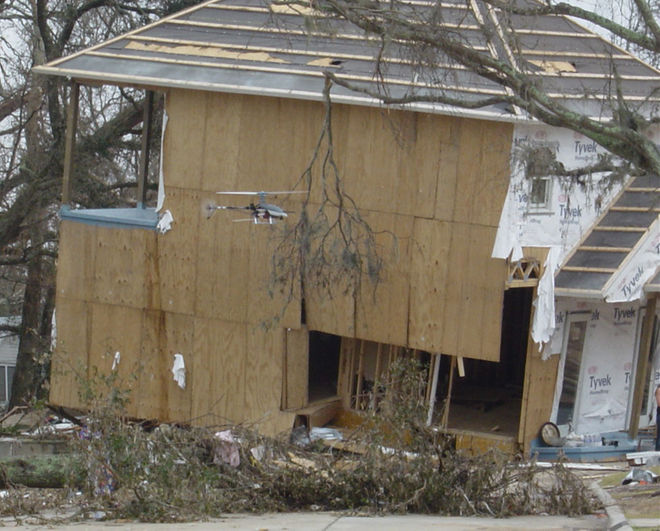
Perhaps the most utilitarian use for drones is in disaster relief. Robin Murphy of Texas A&M University is a proponent of this and has worked to popularize it through the Center for Robot-Assisted Search and Rescue (CRASAR), which first used drones after Hurricane Katrina flooded and destroyed much of New Orleans in 2005. Although drone technology was relatively unadvanced back then, Murphy cited several novel and important uses for drones in an article for space.com:
“CRASAR remotely flew an AeroVironment Raven fixed-wing vehicle in Pearlington, Mississippi. The town had been cut off; all the roads were blocked with fallen trees, and the phone lines were wiped out. The UAV video feed showed that, while the area was heavily damaged, the flooding was subsiding and people were working on clearing out the trees and damage.”
“CRASAR returned with an iSENSYS IP-3 miniature helicopter, specifically designed for inspecting structures. The iSENSYS IP-3 flew 32 flights successfully and examined structural damage at seven multistory commercial buildings. The rotorcraft was able to provide views of the buildings from angles that were impossible to get from the ground or flyovers.”
The last usage was especially novel because the pictures it captured would have been impossible to take any other way. This clearly set the stage for drones saving lives and property. Using drones in the aftermath of Hurricane Katrina was a test of their efficacy—and according to Murphy, they passed: “First, [drones] provide better vantage points and higher-resolution images than satellites or manned planes and helicopters. And second, they deploy faster, and responders can control them tactically.” Since Hurricane Katrina, CRASAR has facilitated disaster relief in 16 additionally instances, most notably in the Fukushima Daiichi nuclear disaster in 2011.
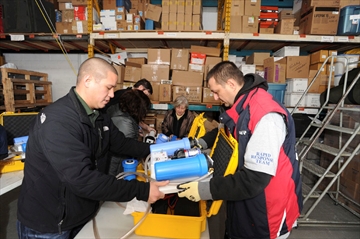
CRASAR isn’t the only organization that aims to use drones in disaster relief: GlobalMedic is a Canadian organization that has done just that in recent events like the 2015 earthquake that ravaged Nepal. Among other forms of relief, the organization aimed to “analyze thousands of photographs shot by [drones] to determine where to distribute water purification units and where to set up 30 inflatable tents… to replace damaged hospitals, health clinics and schools.” Most interestingly, GlobalMedic’s director Rahul Singh offered an additional nuance to Murphy’s idea of what drones can do in disaster relief, telling InsideToronto.com that “If someone calls 911, you send everything. But if someone says they have a broken leg, you know what to send. Nepal is a 911. This tool (UAVs) will be that information we need to know what to send.”
So if you’re ever in an earthquake, hurricane, or something similar, look out above.
Delivering Amazon Products with Amazon Prime Air Drones
Yes, it sounds crazy, and yes, Amazon thinks it will work. “We’ve beefed up a team at Amazon Prime Air that includes aeronautical engineers, roboticists, a former NASA astronaut,” said Paul Misener, Amazon’s vice president for global public policy to Yahoo! News. “These folks are completely focused on making this a reality—and demonstrating that it is safe before we begin operations.”
Amazon has put a slick ad on its website for the service, which is not operational yet. It’s a touching two minute story in which an Amazon drone saves a little girl’s soccer match by delivering a new pair of sneakers after her dog devoured the last pair. Amazon workers pack the sneakers into a regular Amazon cardboard box and put the box on a conveyor belt, which takes it to the drone. The drone lifts off, flies to back yard of the girl’s house and lands. It deposits the box and flies away, leaving the girl smiling. Though some might deride this as a materialist fantasy, the service actually seems quite neat, especially when the technology involved is considered.
Misener explained that Amazon’s drones have a range of over ten miles and can deliver packages of up to five pounds. They are totally automated, not even requiring a pilot on the ground. Additionally, the drones use a “sense and avoid” system that will ensure safety. He compared the drone to a car and a horse:
“These drones are more like horses than cars — and let me explain why. If you have a small tree in your front yard, and you want to bang your car into it for some reason, you can do that…. But try riding a horse into the tree. It won’t do it. The horse will see the tree and go around it. Same way our drones will not run into trees, because they will know not to run into it.”
The major issue with Amazon’s plan is that it requires less federal regulation of airspace to allow for the delivery system it wants. In the Federal Aviation Administration (FAA)’s proposed rules for drones, operators would be permitted to fly drones only within their line of sight, which would destroy Amazon’s endeavor. Operators would be limited to one drone at a time, too. In April of 2015, Amazon sent a letter to the FAA asking it to reconsider the rules, citing recent advances like its sense and avoid system as well as the claim that the FAA would be hindering innovation. Other tech companies like Google, Intel, Verizon, and many drone manufacturers have joined Amazon’s bandwagon.
Despite this legal obstacle, Amazon intends to go through with its plan, and wants its drone to be seen as normal. When asked what would happen if someone shot down one of Amazon’s drones, Misener replied “I suppose they could shoot at trucks, too.” And the idea may have caught on: Alibaba, an Amazon-like firm popular in China has used drones to deliver tea, though system is still limited, and information on it is scarce. France and Switzerland’s postal systems have also started developing drone mail delivery systems too.
Agricultural/Research-based Applications of Drone Use
Imagine for a second that you are large scale farmer; your crops are spread out over thousands of acres, and you have no means of monitoring them all at once, let alone preventing blights and pests from destroying your harvest. How do you tackle this seemingly impossible problem? Once again, it is the UAV which is most instrumental in helping you.
PrecisionHawk is a company which has revolutionized the field of using drones to aid in agriculture and data collection. Their five types of sensors, detecting factors from basic visual observation to highly complex hyperspectral wavelengths in each pixel make them able to detect visibly diseased plants, all the way to small weeds and burrowing pests within each plant.
However, this application of drones gets even better. With the aid of data analysis tools, researchers in all environmentally related fields can collect the information gathered by their drone’s sensory equipment, and compile it into legitimate and complex data analyses. Problems such as unknown crop failures, the impacts of natural disasters and even the effects of global warming are all graphable through the research-application of UAVs.